Helix Fold 101

So we’ve looked at the classic helix piercing, and its popular counterpart, the forward helix. We’ve even discussed the recently popular vertical helixes. So of course, I have to round out the subject by talking about helix fold piercings! Sometimes called catflap or ear rim piercings, these are piercings done through the folded ridge of tissue at the tip or the ear. These are very anatomy-dependent piercings that require a very specific ear to support. But if you do have the right ear for it, it’s such a fun, unique piercing, and I love these so much!
Anatomy
Out of all the helix placements we’ve discussed, helix folds are the most anatomy-dependent, simply because the anatomy for this is not super common. The upper ridge of the ear needs to have a fairly extreme fold that comes far down over the scapula or flat of the ear. This fold can't be fused, meaning there needs to be space on the underside that can accommodate a barbell.
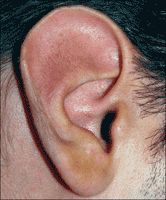

Being honest, the majority of folks do not have an ear shape that would accommodate for helix fold piercings. Their helix rim simply isn’t ‘fold-y’ enough for this! This is a unique piece of ear anatomy that you simply don’t see that often. That said, it’s so cool, and I don’t know a single piercer who isn’t excited about getting to do these unique piercings. Which is great because many clients who do have this anatomy often feel stumped about piercings, assuming that because of this fold they are limited in their options. That couldn’t be further from the truth- they actually have the ability to get some extra unique pieces!
Placement
Your anatomy is the main factor in placement. Some folks have a perfect ear where we can pierce anywhere along the helix fold, and we can discuss placement and have some fun with it. There's plenty of room both along the outer rim of the fold and under it for backings to sit, and we can really get creative. Others may have a ridge where only one or two spots are viable, and we are limited to those areas for placement.

If you are planning on a helix fold piercing, understand that placement may be largely impacted by your anatomy, and come to your appointment with realistic expectations for that.
Other factors that can affect placement are future goals for this piercing. Let your piercer know if you are hoping to eventually do multiple helixes like a double or triple, so we can map things out accordingly. Also, if you know your goal jewelry is a dainty hoop and charms, or big bold ends, let us know that as well! What you want to wear in it and how you choose to style it can also impact what placement on your ear will work best.
Initial Jewelry
For helix fold piercings, straight barbells or labrets are going to be your best option for initial jewelry. Straight pieces sit perpendicular to the tissue and allow things to rest comfortably for healing. The backing style will be determined by your piercer, and there are pros and cons to both bead backs and flatbacks.

On some folks’ ears, bead backs are easier to keep clean, more comfortable, and can tuck nicely into that space under the helix fold. Especially if it is quite tight, the edges of a disc may rub or irritate the cartilage, making a bead more comfortable. However, on some ears, the bead may be too high profile and take up too much space. On others, flat backs may fit far more comfortably, allow us to work around the structures of the ear better, and are lower profile and create more of a “floating” look some clients prefer. I would trust your piercer to make that call and select the style that’s best for you.
Now one of the bigger factors with initial jewelry is what we put on the top of the piercing. I encourage you to start with just simple discs and beads to ensure this heals correctly, and then swap you to more decorative ends once fully healed. This area can easily get caught and snagged, and can struggle with swelling and irritation bumps. Large ends, spikes, and decorative pieces can all be super easy to get caught and snagged and cause issues. It’s much easier to be patient and start with something simple.

The same applies to chains and charms. These pieces are adorable goal pieces for these piercings, but they are so difficult to heal with, so your piercer may suggest waiting to add any dangles till these are more healed.
Healing Expectations
So we understand that there is a range of placements that work for this piercing, almost all determined by anatomy, and that different anatomy may be harder or easier to heal. We know what jewelry we might get, and that jewelry choice and style will also likely affect the healing process. But what is that healing process going to look like? And what about those awful bumps people get? Let’s talk about it.

Helix fold piercings, like most cartilage, on average take about 6-9 months to heal, up to a year. Some folks, due to anatomy, medical conditions, lifestyle, climate, or jewelry choice, may find that it takes a full year or even a little longer for this piercing to be fully healed and comfortable. This is pretty normal, and if you are someone who is a slower healer when it comes to your helix fold piercing, don’t be discouraged- a lot of us are. Side sleepers, people who wear headsets at work, and folks who are just clumsy and catch and snag things more easily are all going to probably have a trickier time healing this.
I have a blog post here that discusses how healing actually occurs in piercings, which is very helpful when it comes to helix fold piercings, if you are curious about specifics of the actual healing. I have another here that discusses aftercare methods.
Many clients will have a fairly uneventful healing process for their helix fold. They’ll get them pierced, probably snag them a few times on pillowcases and shirts and glasses while you adjust to having it there, deal with the back being kind of annoying to clean, and then before you know it, it’s healed and you are changing it in and out without issue. We love to see it!
But, many clients (myself included) will have a bit of a …bumpier ride.
That’s right- the bump. Almost everyone either has experienced this or knows someone who has- getting a little bump or irritation on your piercing at some point during the healing process. I actually have an entire very in-depth article on these bumps and how and why they happen here that I strongly suggest you read. But, I wanna give you some forward helix-specific tips in this blog post.
The first is to consider the basics. Are you sleeping on this side? See, we don’t often realize it but the human head weighs about 8-10 lbs. So when we sleep on our healing piercing that’s 8-10 lbs of pressure all night long. That is a ton of pressure and in helix piercings, this can cause irritation, but it can also cause the piercing to migrate. All that pressure usually pushes the vertical helix at an angle when you lay on that side, for hours and hours all night long. Eventually, the jewelry shifts through the skin and begins to lay at that angle. This migration is often permanent and can result in some pretty nasty bumps. Not sleeping on your ear and downsizing it when it's ready to prevent extra length from getting torqued like that can help prevent this migration. My favorite trick is using a travel pillow like folks use at the airport, and putting my ear in the little space. That way I can still side sleep without crushing my poor piercing all night long. One of the most common reasons we see irritation in helixes is from being slept on, and this is the culprit for dozens and dozens of bumps.
The next most common issue is with keeping these clean. The natural crust and secretion that forms of healing piercings is usually fairly easy to clean away. But helix folds are tricky for two reasons- the first is that they are hard to see! The outside is easy to spot perched above your ear but the fold itself hides the back, much like a forward helix. This creates a place for crust and debris to build up under that fold where you can’t easily see it or get to it. The other is the narrow, tight space these rest in. The helix fold is often very close to the flat, and this small space is full of creases and creases for debris and crust to build up. Combine a tight, tricky-to-clean area with also being hard to see, and many clients struggle with getting and keeping these piercings clean. My favorite trick for this is using a pointy q-tip.

These have fine, delicate pointed ends originally designed for precision makeup cleanup around your eyes. They are more tightly woven than your average q-tip and less likely to leave fibers behind. You can soak them in saline and use them to gently clean around the back of your forward helix. The key word there is gentle- you want to remove that crust and debris, not bash your piercing around with it. Be mindful of the q-tip getting caught or snagged on any ping or gem ends, and try not to disrupt the jewelry too much during cleaning.
Have you caught or snagged this recently? Helix folds are a pretty high-traffic area that can get a good bonk or snag somewhat often- especially tucking our hair back, taking glasses on and off, wearing hats or wigs, and taking shirts off. These can absolutely cause the piercing to become irritated. If you did, and that’s the cause of your bump, then some extra TLC and care & some time, and patience are all this needs to heal right up. What about being sick recently? A cold or the flu? Maybe seasonal allergies, or even seasonal weather change? When you are sick, and your whole body is sick, then your piercing understandably is going to be all grumpy too. Focus on getting yourself feeling better- your piercing can’t recover until you have recovered first!
And then consider some other factors. What jewelry were you pierced with- Did you opt for something ideal for healing like a high-quality implant-grade titanium labret post, or did you get the “one size fits all” piercing gun earring….maybe steel? Did you decide on the extra-large spike that gets snagged a bit more often or did you play it safe with something smaller and less likely to catch? As we discussed above, some jewelry styles can affect how this piercing heals, and you may be experiencing a bump as a side effect of this jewelry style, material, and quality.
Perhaps there is an issue with aftercare that could be causing this irritation. Often clients, accidentally end up getting products like hair spray, gel, or dye into their helix piercings that can cause the piercing to become very irritated. Sometimes it's an external factor like wearing a mask, headphones, or a scarf.
Whatever the cause, if you have a bump or an issue with your piercing it’s important to get back in touch with your piercer so they can help you determine the cause of the irritation and how to treat it. If it’s grumpy because you snagged it, it likely just needs some patience and time to recover. If it’s irritated because you have a low-quality, “one size fits all” butterfly back, you likely need to get better-quality jewelry. And if it's becoming irritated from being slept on, you may need to get a travel pillow and change your routine to allow it to recover. Your piercer's job isn’t over just because they did your piercing- a huge part of our job is then helping you heal that piercing!
There you have it folks, a comprehensive breakdown on all of the things to consider when getting your helix fold pierced! These anatomy-dependent piercings are super fun, super unique, and I think they are the perfect stand-alone or complement to an existing setup. I hope this blog post can help you prepare and make some informed choices about placement, jewelry, and aftercare. Happy healing!